
Graduate education increasingly emphasizes developing students as both practitioners and scholars, yet many online graduate programs provide limited opportunities for students to participate in authentic, collaborative research beyond required coursework. While online learning offers flexibility and increased access, it can also make it difficult for students to build scholarly relationships and engage meaningfully in academic research. Previous studies have documented the value of mentoring, collaborative learning, and communities of practice in graduate education (Nolte et al., 2015; Pfund et al., 2016), but little is known about how faculty-led research teams function within fully online professional doctoral programs or how these teams influence researcher identity, motivation, and belonging. Guided by critical mentorship theory, we used mixed methods to examine the experiences of online Doctor of Education (EdD) students and alumni who voluntarily participated in a faculty-led systematic literature review to better understand how relational, structural, and mentoring practices within collaborative research experiences support researcher identity development and sustained engagement.
Researcher Identity Development in Graduate Education
Researcher identity, how doctoral students come to see themselves within an academic community, is a foundational element of graduate education. It is a complex and dynamic construct shaped by personal, emotional, and intellectual growth over the course of doctoral studies (Leshem, 2020). When students develop a strong researcher identity, they gain the confidence and agency to navigate academic expectations, persist through challenges, and establish themselves within their fields (Leshem, 2020; Mantai, 2017; Zhang et al., 2024). The literature points to two interrelated pathways through which this identity develops: social interaction and active research practice. Engaging with peers, supervisors, and the broader research community, even through informal conversations about research, provides the relational scaffolding through which students begin to see themselves as active members of a scholarly community (Baker & Pifer, 2014; Donaghue & Adams, 2025; Mantai, 2017). At the same time, actively participating in research activities, writing, publishing, and responding to feedback deepens a student’s sense of themselves as a researcher over time (Inouye & McAlpine, 2017; Lu et al., 2026; Mantai, 2017; Nouri, 2024). Together, these dimensions suggest that researcher identity emerges at the intersection of community and contribution.
While these developmental pathways apply broadly to doctoral education, EdD students face distinct challenges that can complicate the process. Unlike traditional PhD students, EdD students often balance dual roles as practitioners and researchers, creating tension and even identity conflict as professional responsibilities compete with the time and energy required for scholarly engagement (Buss, 2022; Geesa et al., 2020). As a result, novice researchers in professional doctoral programs often complete their studies with limited experience contributing to collaborative research and fewer opportunities to develop confidence in their identities as researchers (Kirk & Lipscombe, 2019). Given these challenges, structured mentorship and peer support become especially important in helping EdD students navigate identity development and bridge the gap between practitioner experience and scholarly engagement by providing the relational and intellectual support students need to begin seeing themselves as researchers rather than consumers of research (Geesa et al., 2020).
Sense of Belonging in Online Graduate Programs
Sense of belonging is widely recognized as a crucial factor in student satisfaction, retention, and persistence in online graduate programs. Students who feel connected to a learning community are more likely to persist and succeed in their studies (Berry, 2017; Delmas, 2017). However, the physical distance inherent in online learning makes it more difficult for students to build scholarly relationships, receive mentorship, and develop a sense of inclusion within an academic research community. Researchers have identified several structural approaches that can address this challenge. For example, research on online doctoral student persistence indicates that academic and social integration, along with institutional support, are important to building a community of belonging (Rockinson-Szapkiw et al., 2016, 2019). At the curricular level, students in cohort models may experience less isolation through participation in a stable peer group (Blankenship & Gibson, 2016), while synchronous and asynchronous activities in blended and online courses may increase interaction and inclusiveness (Mendoza & Venables, 2023).
Even the most thoughtfully designed program structures, however, depend on active faculty involvement to bring a sense of community to life. Faculty who promote connection, closeness, and interactivity help students feel more included and engaged (Berry, 2017), and research groups have been identified as an effective strategy for sustaining community across various types of programs (Bolliger et al., 2019). Faculty-led research teams are a particularly promising vehicle for this kind of investment. Unlike coursework, which is bounded by semesters and assignments, research teams offer a sustained context in which relationships can deepen over time, and students can experience themselves as valued contributors to a shared scholarly endeavor. When faculty take an active role in fostering connection within these teams, the structural benefits of collaboration converge with the relational dynamics that make belonging possible, positioning research teams as a powerful mechanism for addressing one of online graduate education’s most persistent challenges.
Faculty-Led Research Teams as High-Impact Learning Experiences
Faculty-led research teams allow students to engage in authentic research alongside faculty and peers while developing skills, learning research practices, and contributing to shared scholarly goals. Research groups have long been recognized as central to doctoral education, fostering learning and professional development through mentored experiences (Crede & Borrego, 2012). At the heart of these teams is an apprenticeship model that pairs novice scholars with experienced faculty who guide them through the complexities of the research process (Crede & Borrego, 2012; Feldman et al., 2013). These models are now being adapted for online contexts, where feedback and guidance can be provided through virtual research groups and online communities, supporting both skill development and professional identity formation (Crede & Borrego, 2012; Feldman et al., 2013). Closely related is the concept of communities of practice (CoPs), which provide a broader framework for understanding how collaborative scholarship functions in online environments. Online CoPs facilitate shared inquiry, feedback, and knowledge construction through structured interactions and social networking tools (Billingsly & Peiser, 2026; Fitzpatrick, 2014; Tummons, 2024). When faculty-led research teams operate as COPs, they offer something neither coursework nor independent study can easily replicate: a sustained, relational context in which students learn not only research methods but also the norms, values, and habits of mind that define scholarly communities.
Despite the promise of these models, significant gaps remain in our understanding of how they function in fully online professional doctoral programs. Although existing studies have documented the importance of mentoring, collaborative learning, and communities of practice in graduate education (Nolte et al., 2015; Pfund et al., 2016), few have explored how these elements work together within faculty-guided research teams in online settings. Even less is known about how equity-oriented mentoring structures and near-peer collaboration contribute to researcher identity development or sustain engagement in long-term research projects. Without empirical evidence on how voluntary research teams influence researchers’ identity, motivation, and sense of belonging among online graduate students, programs lack the guidance needed to design experiences that go beyond skill-building to foster the deeper relational and identity-level transformations that sustain scholarly engagement over time.
Theoretical Framework: Critical Mentorship Theory
This study draws on critical mentorship theory as a framework for understanding how relational and structural features of mentorship shape access, belonging, recognition, and meaningful participation within scholarly communities. The framework is particularly relevant because it offers a lens for examining how faculty-led research experiences can create opportunities for novice researchers to contribute to knowledge production, develop a sense of belonging within a research community, and strengthen their identities as researchers.
Pfund et al. (2016) and Weiston-Serdan (2023) describe critical mentorship as an equity-oriented practice that extends beyond the traditional transfer of knowledge from mentor to mentee. Within this framework, scholars have identified power, access, identity, and opportunity as important considerations in mentoring relationships, emphasizing the creation of conditions that allow mentees to participate meaningfully in professional and scholarly communities. Effective mentorship requires responsiveness to individual needs while providing access to the knowledge, relationships, experiences, and opportunities necessary for continued development (Pfund et al., 2016). Weiston-Serdan (2023) further highlighted relationship-building, shared storytelling, and attention to equity as important, especially when supporting individuals who have historically experienced exclusion from academic spaces. Critical mentorship theory is particularly relevant to faculty-led research teams because research mentorship occurs in environments where faculty traditionally hold greater institutional and scholarly authority than students. Practices including voluntary participation, transparent authorship expectations, peer-led research sessions, and opportunities for continued participation after graduation may reduce some of this traditional hierarchy by positioning students as contributors to knowledge production rather than merely learners of research.
Methodology and Sample
In 2024, a group of online EdD students volunteered to participate in a systematic literature review of mixed methods studies and dissertations published in the last 10 years. The task of analyzing the publications was extensive, with students joining and leaving the project over the past two years. An EdD faculty member led the project, coordinating the various phases of the review using the Covidence platform. Three research questions guided this convergent mixed methods study:
-
Quantitative: Do novice researchers’ self-efficacy and sense of belonging predict research motivation and identity?
-
Qualitative: How do participants in a collaborative research team describe shifts in their researcher identity, sources of sustained engagement, and motivations for future research?
-
Mixed Methods: How do the quantitative and qualitative data converge to explain novice researchers’ motivation and identity?
Participants were online EdD students and alumni who engaged in the systematic review. We utilized total population sampling and sent recruitment emails to the 100 individuals who worked on the research project. Of the 27 responses, most participants identified as White (n = 20, 74.1%) women (n = 21, 77.8%), who were between the ages of 35 and 44 (n = 10, 37.1%) at the time of the study. Most (n = 14; 51.8%) indicated that they worked on the project when they were a graduate student in the EdD program, while 8 (29.6%) were alumni, and 5 (16.7%) began the project as a graduate student and continued to work on it after graduating from the program. Participants indicated that they worked on the project for 1-3 hours per week (n = 16; 59.3%), followed by less than one hour (n = 9; 33.3%), and more than three hours (n = 2; 6.7%).
We were interested in learning what motivated or encouraged participants to work on the project, as well as what barriers kept them from contributing to it. Participants could select more than one motivator and barrier. Of the options, most participants indicated that they were motivated by opportunities to develop research skills (n = 21, 77.8%), a sense of responsibility to the team (n = 18, 66.7%), and a desire to contribute to meaningful work (n = 17, 62.9%). Participants indicated that demands from work or school (n = 17, 62.9%), competing personal or family responsibilities (n = 17, 62.9%), and limited time or capacity (n = 14, 51.8%) were the primary barriers to their participation. Table 1 displays the specific results.
Data Sources and Findings
To examine the impact of participation in the research team, we constructed a survey using items adapted from three validated scales (see Appendix). We selected items that assessed the three constructs examined in this study: researcher confidence, sense of belonging, and researcher identity development.
Participants completed an online survey that included background and research-team participation questions and items addressing motivations for and barriers to continued participation. The survey also included four sets of Likert-scale items assessing research self-efficacy, sense of belonging, and research motivation and identity. We adapted research self-efficacy items from the Science Self-Efficacy Scale (Higher Education Research Institute [HERI], 2017), sense of belonging items from the Psychological Sense of School Membership Scale (Goodenow, 1993), motivation and identity items from the HERI Science Identity Scale (HERI, 2017) and the hope and optimism subscales of the Psychological Capital Questionnaire (Luthans et al., 2007). The survey concluded with three open-ended questions addressing shifts in researcher identity, leadership or mentorship practices that supported engagement, and motivation for future research. Appendix A provides the complete participant survey.
We adapted 10 items from the Science Self-Efficacy Scale (Higher Education Research Institute [HERI], 2017) for Section A and asked participants to respond using a 5-point Likert scale. These items assessed participants’ confidence in research skills, including study design, data analysis, and interpretation of findings. For Section B, we adapted six items from the Psychological Sense of School Membership Scale (Goodenow, 1993) and asked participants to respond using a 5-point Likert scale. These items assessed participants’ perceptions of belonging, respect, and inclusion within the research team. For Section C, we made minor adaptations to the six items from the Science Identity Scale (HERI, 2017) and the hope and optimism subscales of the Psychological Capital Questionnaire (Luthans et al., 2007) and asked participants to respond using a 5-point Likert scale. These items assessed participants’ researcher identity and motivation, including how they viewed themselves as researchers, their motivation to conduct future research, and their persistence when encountering research-related challenges. Finally, we developed three open-ended questions for Section D. We asked participants to describe changes in their researcher identity, leadership or mentorship practices that influenced their engagement, and the influence of team participation on their motivation to conduct future research. We used participants’ responses to these three prompts as the qualitative data for this study.
We analyzed the quantitative and qualitative data separately and then integrated them to address the three research questions. Quantitative analyses included descriptive statistics and multiple regression analysis. For the qualitative analysis, researchers reviewed participants’ responses to the three open-ended questions and identified patterns related to researcher identity, engagement, mentorship, and motivation. We organized these patterns into three themes: Becoming a Researcher, Learning Through Community, and Confidence Through Contribution. We then integrated quantitative and qualitative findings to examine areas of convergence and provide additional context for understanding researcher identity and motivation. Table 2 summarizes the data sources, analytic approaches, and primary findings associated with each research question.
Quantitative Findings
The survey assessed three constructs: researcher self-efficacy, sense of belonging, and researcher identity and motivation. Participants rated all items on a 5-point Likert-type scale ranging from 1 (Strongly Disagree) to 5 (Strongly Agree), with higher total scores indicating higher levels of the respective construct.
Participants (N = 27) generally reported positive perceptions across the three constructs. Researcher self-efficacy, measured using 10 items with a possible score range of 10 to 50, had observed scores ranging from 36 to 50 (M = 43.56, SD = 3.68). The mean total score corresponded to an average item response of 4.36 out of 5, indicating that participants generally reported high levels of confidence in their research-related knowledge and skills. Item-level descriptive statistics reveal that participants rated the item “I can identify the type of research design in a given study” highest (M = 4.81, SD = .39) and the item “I can identify appropriate integration strategies for a given mixed methods study” (M = 3.96, SD = .71) lowest on this scale (see Table B1 in Appendix B). This underscores our belief that teaching the integration phase of mixed methods research is critical in graduate programs.
The survey also assessed participants’ sense of belonging using six items, resulting in a possible score range of 6 to 30. Observed scores ranged from 15 to 30 (M = 21.48, SD = 4.70), corresponding to an average item response of 3.58 out of 5. Although participants generally reported positive perceptions of belonging within the research team, scores demonstrated greater variability than researcher self-efficacy. Participants rated each item on this scale similarly (see Table B2 in Appendix B).
Similarly, the researcher identity and motivation construct included six items, with possible scores ranging from 6 to 30. Participants’ scores spanned from 16 to 30 (M = 26.00, SD = 3.96), corresponding to an average item response of 4.33 out of 5. These findings suggest that participants generally reported strong researcher identity and motivation, including motivation to engage in research beyond their coursework, persistence when encountering research challenges, and optimism about their future involvement in research. While participants rated all items similarly, (see Table B3 in Appendix B), they rated the item “Being a researcher is an important part of who I am” the lowest (M = 4.07, SD = .83). Given that the participants were all scholarly practitioners rather than traditional doctoral students, this result is not surprising.
We also conducted a multiple regression analysis to examine whether researcher self-efficacy and sense of belonging predicted researcher identity and motivation. The overall regression model was statistically significant, F(2, 24) = 3.74, p = .04, and accounted for approximately 24% of the variance in researcher identity and motivation. The unstandardized regression equation was: Researcher Identity and Motivation = 22.19 - 0.13(Researcher Self-Efficacy) + 0.45(Sense of Belonging). Table 3 presents the multiple regression results.
Examination of the individual predictors revealed that sense of belonging was the only statistically significant predictor of researcher identity and motivation (p = .01). Researcher self-efficacy was not a statistically significant predictor (p = .54). Although participants generally reported high levels of research self-efficacy, differences in self-efficacy did not significantly predict differences in researcher identity and motivation within this sample. In contrast, a greater sense of belonging was associated with stronger researcher identity and motivation. This finding is particularly notable when considered alongside participants’ self-reported motivations for joining the research team.
Participants identified nine different reasons for participating in the project. Interestingly, a sense of community or belonging ranked seventh, with 11 participants (40.7%) identifying it as an initial motivator. As a result, belonging was not among the most frequently reported reasons participants initially chose to engage in the research experience. Nevertheless, participants’ subsequent sense of belonging within the team emerged as the only statistically significant predictor of researcher identity and motivation. This contrast suggests that the factors that initially draw graduate students into collaborative research experiences may differ from those associated with the development of their identities and motivation as researchers.
Qualitative Themes
Through qualitative analysis, we identified three interconnected themes: Becoming a Researcher, Learning through Community, and Confidence through Contribution. Across these themes, participants described development that extended beyond acquiring research skills. They discussed changes in how they viewed themselves as researchers, how they learned through relationships with faculty and peers, and how meaningful participation contributed to greater confidence in their ability to engage in scholarly work, as outlined in Table 4.
Becoming a Researcher
Participants described changes in how they understood themselves in relation to research. For several participants, repeated engagement with research activities contributed to a shift from completing research tasks to recognizing themselves as researchers. One participant described this transition directly:
After evaluating many studies, I began asking deeper questions, not just about what I was seeing, but why it mattered and how it connected to broader conversations in the field. That’s when I realized I wasn’t just completing a research project—I was becoming a researcher.
Another participant similarly explained, “I felt like it wasn’t just me reading for understanding of the methods, but I was also engaging with the texts.” For others, recognition of their ability to contribute extended beyond the research team. One participant recalled explaining the project to a family member and realizing, “I had expertise and skill that were meaningfully contributing to something outside of my ‘day job.’”
These experiences involved increased familiarity with research methods and growth as scholars. Participants began to recognize their knowledge, contributions, and capacity to participate in scholarly work, reflecting an emerging sense of themselves as researchers. Researcher identity develops through participation in research practices and interactions with members of scholarly communities (Baker & Pifer, 2014; Mantai, 2017). In the present study, participants engaged in authentic research activities that allowed them to apply their knowledge and contribute to a shared scholarly project.
Viewed through critical mentorship theory, these changes in participants’ perceptions of themselves may reflect the importance of access, recognition, and meaningful participation in scholarly communities (Pfund et al., 2016; Weiston-Serdan, 2023). Through sustained engagement in authentic research and opportunities to contribute to knowledge creation, participants evolved from students of research into valued members of a research community. For some participants, this recognition and participation seemed to catalyze a shift in self-perception toward that of a researcher contributing to scholarly work.
Learning Through Community
Participants described connection, encouragement, and knowledge exchange as important aspects of their experiences within the research team. Rather than describing faculty members as the only source of support, participants discussed relationships with both faculty and peers. One participant explained that “the sense of community that has been built into the entire process has been helpful,” adding that communication among team members created a “community-driven feel” to the work. Another participant described how encouragement restored their engagement after a period of inactivity: “I realized I wasn’t the only one who got stuck or stalled out. The encouragement and connection brought me back to the work.”
Participants also described recognition of their contributions as important to continued participation. One participant explained that encouraging emails from the project leader “motivated me and made me feel that my help mattered.” Another described the significance of being invited to participate: “The leader of this project saw something in me that added value to the project.” Across these responses, participants experienced support through both interpersonal connection and recognition of the value of their contributions.
These experiences are consistent with the social dimensions of researcher identity development described in previous scholarship (Baker & Pifer, 2014; Mantai, 2017). Within the research team, participants could receive encouragement, contribute their own expertise, and interact with individuals at different stages of researcher development. Current students, alumni, peers, and faculty therefore participated in relationships that extended beyond a traditional faculty-to-student mentoring structure.
Within critical mentorship theory, these relationships are relevant to recognition, access, and meaningful participation. Participants were not positioned solely as recipients of faculty expertise; they also participated as contributors and members of a research community. Recognition from faculty and peers may have reinforced participants’ perceptions that their contributions mattered and that they belonged within the scholarly community.
Confidence Through Contribution
Participants associated continued participation in the research project with increased confidence in their research abilities. Several participants described gaining confidence as they repeatedly applied research skills. One participant explained, “I got more comfortable with the goals and expectations of the project as I continued. As I became more comfortable with the project, I became a more confident researcher.” Another described beginning the project “extremely self-conscious” about making an incorrect interpretation, but becoming “more comfortable and confident” with analysis over time.
For some participants, this increased confidence extended to future scholarly activity. One participant reported, “I actually submitted two proposals to individual conferences about subjects that I’m interested in,” and connected that decision to “seeing myself as a capable contributor to this process, and a valued researcher.” Another participant stated that the experience “increased my confidence in conducting future research” and increased their ability to “lead or collaborate on research projects with greater clarity and purpose.”
These responses are important when considered alongside the quantitative results. Participants generally reported high researcher self-efficacy, but researcher self-efficacy was not a statistically significant independent predictor of researcher identity and motivation. Participants’ descriptions indicate that confidence nevertheless remained an important aspect of their experiences. Rather than uniformly entering the project with confidence in their research abilities, several participants described becoming more confident through repeated participation, application of research skills, and contributions to meaningful scholarly work.
The distinction between confidence as a predictor and confidence as a developmental experience may help contextualize the quantitative and qualitative findings. Participants did not necessarily need to begin as confident researchers to contribute meaningfully to the team. For some, opportunities to participate and contribute were associated with increased confidence in their ability to conduct future research.
Integrated Analysis
Integration of the quantitative and qualitative findings revealed that researcher development within the faculty-led research team was shaped by more than participants’ perceptions of their research skills. The quantitative analysis demonstrated that the overall regression model significantly predicted researcher identity and motivation, accounting for approximately 24% of the variance. However, sense of belonging was the only statistically significant independent predictor. Researcher self-efficacy, despite being relatively high among participants, did not significantly predict researcher identity and motivation. The qualitative findings provide additional context for understanding this result and suggest three related meta-inferences concerning belonging, authentic participation, and collaborative mentorship. Table 5 presents this integration.
The qualitative theme of Learning through Community helps explain how belonging may be the primary pathway to researcher identity. Participants described encouragement from peers, opportunities to learn alongside others, and relationships that extended across students and alumni. These experiences suggest that community was not necessarily something participants expected to gain when entering the project. Instead, belonging may have developed through repeated experiences of collaboration, recognition, and reciprocal support. In this sense, participants may have entered the project seeking research experience but subsequently discovered that relationships within the research community were central to sustaining their participation and shaping their researcher identities.
Second, integration of the findings suggests that researcher identity developed through authentic participation in scholarly work. The theme of Becoming a Researcher reflected participants’ increasing ability to recognize themselves as researchers as they engaged directly in research activities. This finding is consistent with the relatively high levels of researcher identity and motivation observed quantitatively. Rather than researcher identity developing solely from learning research concepts or increasing confidence in research skills, participants’ accounts suggest that actually contributing to research provided experiences through which they could begin to claim a researcher identity.
This finding is important in an online EdD context. Professional doctoral students frequently occupy simultaneous identities as practitioners, students, and emerging scholars. A collaborative research team can provide a space where participants move beyond completing research-related coursework and instead engage in the practices associated with scholarly knowledge production. Through meaningful contribution, feedback, collaboration, and dissemination, participants can receive both experiential and social confirmation that they are capable of occupying the role of researcher.
Third, the integrated findings suggest that collaborative mentoring structures may support sustained research engagement beyond the acquisition of research skills. Qualitative responses highlighted aspects of the team’s structure, including opt-in participation, transparent authorship, peer-led sessions, and opportunities for students and alumni to work together. These practices may have created conditions in which participants could remain involved according to their available capacity while still perceiving themselves as valued members of the research community. This flexibility is particularly relevant given that participants identified work or school demands, personal or family responsibilities, and limited time or capacity as their most common barriers to participation.
The combination of flexibility and meaningful contribution may be especially important for online professional doctoral students. An opt-in structure allowed participants to adjust their involvement around competing responsibilities without necessarily severing their relationship with the research community. Transparent authorship and opportunities for dissemination also provided visible recognition of scholarly contributions. Peer-led and alumni-inclusive structures expanded opportunities for mentorship beyond a single faculty-to-student relationship. Collectively, these practices align with critical mentorship theory by creating multiple avenues for participation, recognition, and shared scholarly ownership.
The integrated findings also complicate the role of researcher self-efficacy. Although participants generally reported high research self-efficacy and qualitatively described increased confidence, self-efficacy was not a statistically significant independent predictor of researcher identity and motivation. The confidence through contribution theme suggests one possible explanation: confidence may develop through successful participation and contribution rather than functioning solely as an antecedent to researcher identity. Participants did not necessarily need to perceive themselves as fully confident researchers before contributing meaningfully to the team. Instead, participation may have provided opportunities to develop confidence through experience.
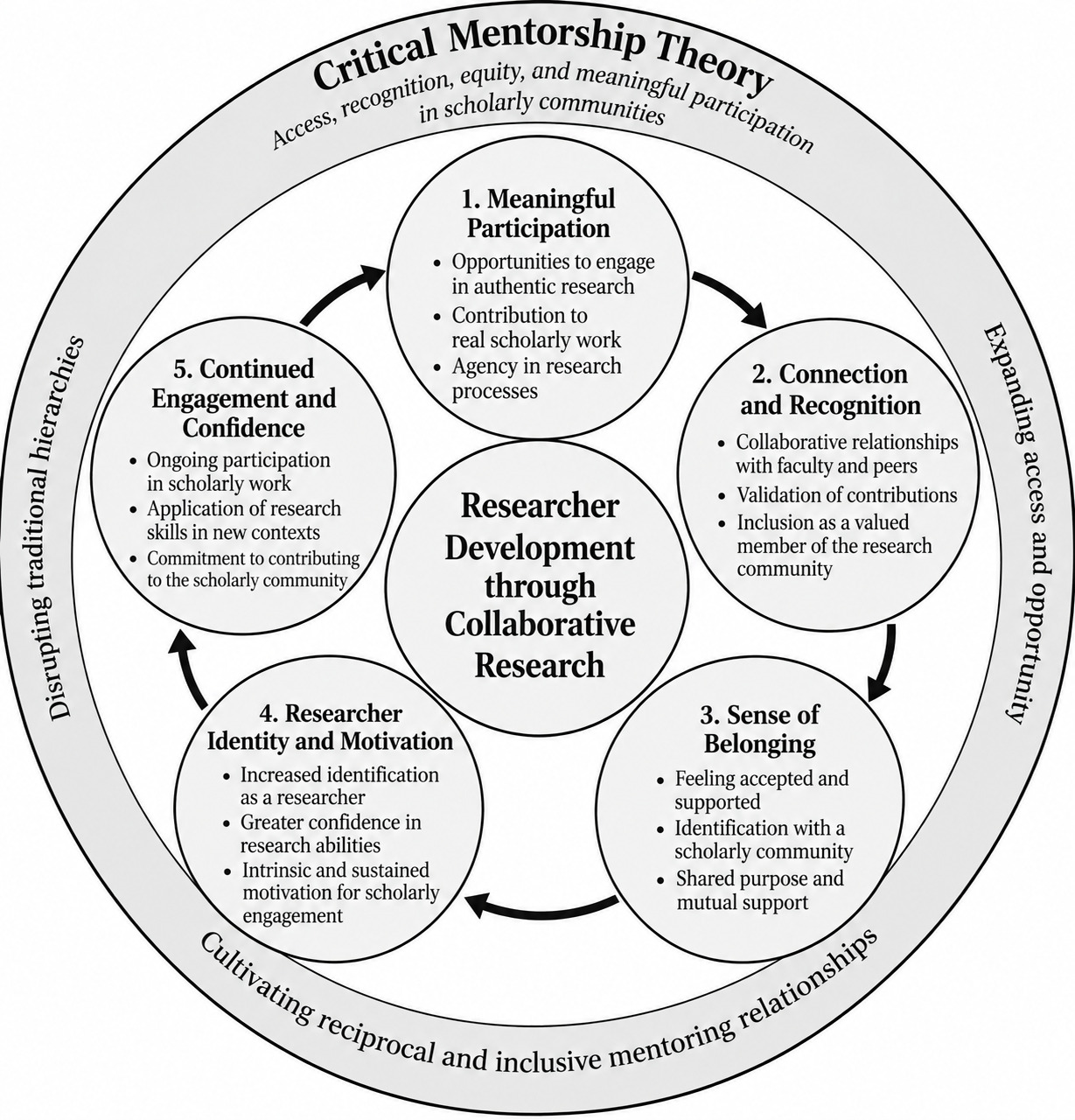
Taken together, these findings suggest a potentially reciprocal developmental process. Meaningful participation created opportunities for connection and recognition; connection strengthened participants’ sense of belonging; belonging was associated with stronger researcher identity and motivation; and increasingly identifying as a researcher may have encouraged continued participation and contribution. Because the present study used a cross-sectional design, the direction or causal sequence of these relationships cannot be established. Nevertheless, the convergence of quantitative and qualitative findings suggests that researcher development within collaborative research teams is relational as well as skill-based. Figure 1 illustrates the developmental process suggested by the convergence of quantitative and qualitative findings.
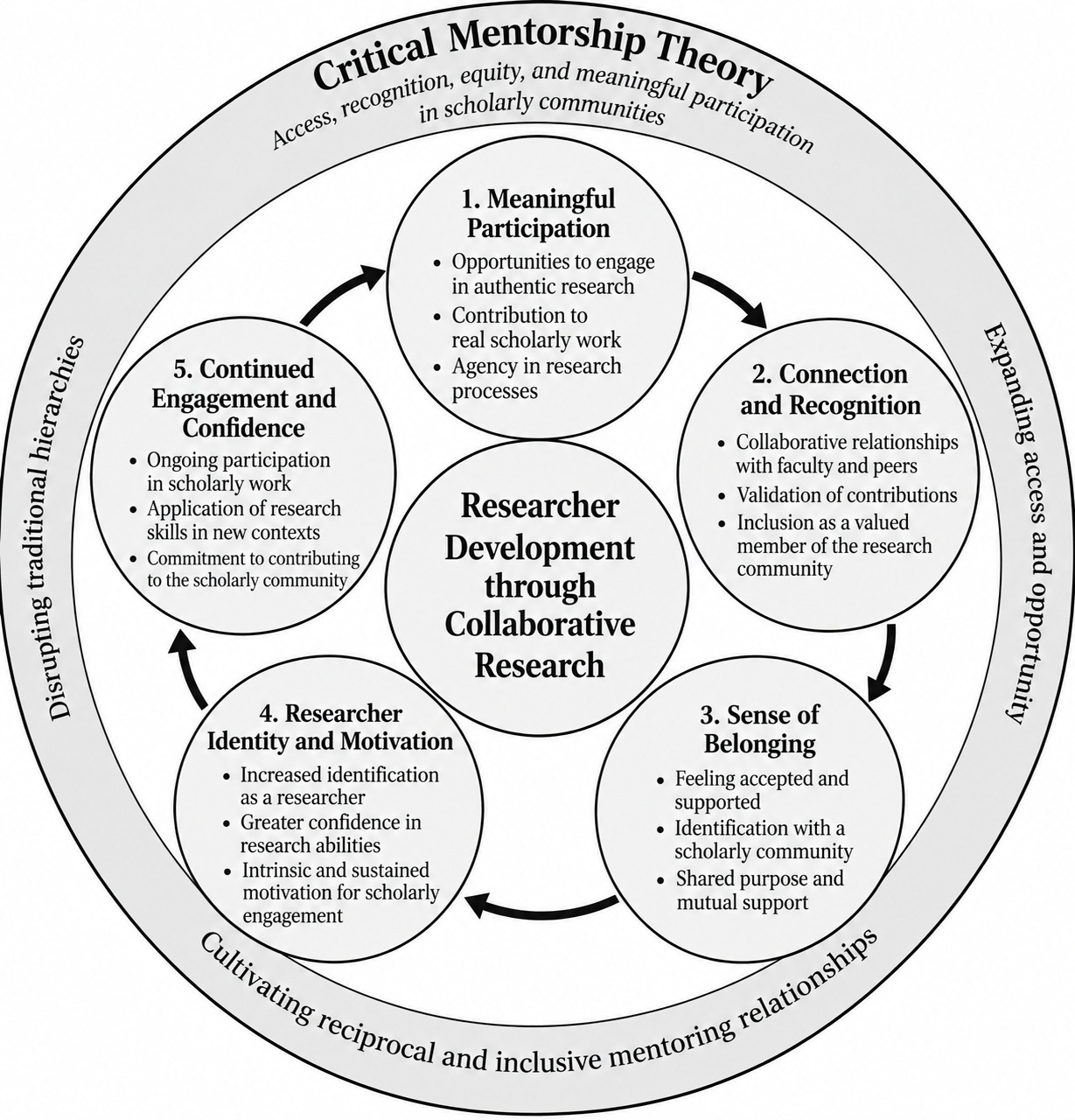
Viewing the findings through the lens of critical mentorship theory, the study results can help explain how access to meaningful scholarly participation, reciprocal relationships, recognition, and inclusion within a research community can foster the development of researcher identity (Pfund et al., 2016; Weiston-Serdan, 2023). Participants’ descriptions suggest that opportunities to participate in authentic research and be recognized as valued contributors shaped how they came to see themselves as researchers. Consequently, developing researchers in online graduate education programs may require more than teaching research skills or increasing methodological confidence. Creating spaces where novice researchers feel valued and legitimate as contributors to a scholarly community may be equally, or even more, important to developing researcher identity and sustaining motivation.
Significance of Findings
The findings from this study offer insight into how participation in a faculty-led collaborative research team may contribute to researcher development among students and alumni in an online professional doctoral program. Across the quantitative and qualitative findings, participants described development that extended beyond research skill acquisition to include researcher identity, belonging, confidence, and engagement within a scholarly community. The following sections consider the scholarly significance of these findings, their implications for faculty-led research teams and graduate education, directions for future research, and the limitations of the current study.
This study highlights how equity-focused, faculty-supported research teams can influence both the researcher’s identity and a sense of connection among graduate students in online settings. Rather than taking a top-down approach, this study emphasized mentoring as a shared and intentional practice, reflecting the goals of critical mentorship theory (Pfund et al., 2016; Weiston-Serdan, 2023). Participants actively helped plan the project, analyze the data, and contribute to the writing process. In doing so, they gained ownership over their scholarly development, and traditional power structures were rebalanced to support that growth.
The findings also highlight how critical mentorship can facilitate developing researcher identity through access, recognition, and meaningful participation in scholarly work (Pfund et al., 2016; Weiston-Serdan, 2023). The faculty-led research team did not see participants as students learning research skills, but as participants with an opportunity to contribute to authentic research, to collaborate with faculty and peers, and to have their contributions recognized in the research community. These relational and participatory experiences are in line with critical mentorship’s focus on disrupting traditional hierarchies between mentors and mentees and offering more reciprocal opportunities to learn and contribute (Weiston-Serdan, 2023). The participants’ stories of growing confidence and beginning to see themselves as researchers also suggest that meaningful participation in a supportive scholarly community may be a factor in researcher identity development (Baker & Pifer, 2014; Mantai, 2017).
Collectively, these findings indicate that critical mentorship may function through the acquisition of research skills and through the relational conditions that enable novice researchers to see themselves as legitimate and valued contributors to knowledge production. The results offer a clear response to the study’s guiding questions, showing how participants developed as researchers through both measurable trends and personal experiences. Quantitative findings revealed that a sense of belonging played a more significant role in shaping researcher identity and motivation than self-efficacy. Participants often highlighted the importance of peer encouragement, shared ownership, and supportive mentoring in their experience. When viewed alongside the quantitative results, the integrated data suggested that while gaining confidence mattered, what made the most significant difference was feeling genuinely seen, included, and valued as part of the research community. This study provides empirical evidence that equity-oriented, faculty-guided research teams can cultivate researcher identity and community in online graduate education. By delineating effective leadership tactics, this research offers a transferable model for institutions seeking to humanize digital learning, enhance retention, and diversify scholarly knowledge production.
Implications, Limitations, and Future Research
This study offers six practical implications for institutions seeking to support researcher development in online graduate programs, organized around three areas: team design, mentorship, and recognition.
Team Design
Faculty-led research teams should be viewed as departmental assets. Collaboration among faculty, students, and alumni advances a shared research agenda while simultaneously developing participants’ knowledge and capacity. To sustain this collaboration, institutions should adopt an opt-in, rolling participation model, recruiting at natural transition points such as the start of a semester or the completion of a relevant course. This structure accommodates fluctuations in participants’ time and allows sustained engagement without rigid commitments.
Mentorship
Institutions should actively include alumni as contributors to collaborative research projects. Alumni bring unique professional experience, benefit from continued scholarly engagement, and can serve as mentors to current students. More broadly, near-peer mentoring, in which more advanced students and alumni guide newer participants, should be encouraged. While these relationships often emerge organically, faculty leads should intentionally nurture them to extend mentorship beyond a single faculty-to-student dynamic.
Recognition
When multiple contributors participate in data collection or analysis, lead faculty should establish transparent authorship policies that clarify from the outset how work is credited. Beyond formal authorship, institutions should celebrate the broader team’s contributions — whether through a group email or a larger gathering — to reinforce that all contributions matter, not only those tied to a specific publication or presentation.
Limitations
This study has six limitations. First, all participants attended a single institution’s online EdD program, limiting generalizability. Second, participation was voluntary, and respondents could complete the qualitative portion, the quantitative portion, or both. Third, all data were self-reported and collected independently, without researcher supervision. Fourth, the sample was small (n = 27 completed all measures), which constrains statistical power. Fifth, positive response bias is possible, given that participants were themselves researchers familiar with survey design. Sixth, the cross-sectional design captured data at a single point in time, precluding conclusions about directionality or change over time.
Future Research
Several directions would extend these findings. Comparing collaborative research teams across multiple institutions, varying in program size, degree type, and modality, would clarify the conditions under which these teams are most effective. Comparing PhD and EdD contexts may reveal meaningful differences. Longitudinal studies tracking participants’ self-efficacy, research engagement, and graduation rates over time would strengthen causal claims, as would examining how sense of belonging evolves during and after participation.
Conclusion
This study demonstrates that faculty-led research teams can serve as meaningful spaces for researcher development in online professional doctoral programs. Across both quantitative and qualitative findings, a sense of belonging emerged as a central factor in shaping researcher identity and motivation, even though participants did not initially seek community when joining the team. Through collaborative engagement, peer support, and sustained contribution to authentic scholarly work, participants moved beyond skill acquisition to experience genuine shifts in how they understood themselves as researchers. These findings suggest that supporting researcher development in online graduate education requires both methodological training and a relational environment where novice scholars feel valued and recognized as legitimate contributors to knowledge production. By integrating equity-oriented mentorship practices, flexible participation structures, and transparent recognition of contributions, institutions can foster the conditions under which online doctoral students not only learn to do research but come to see themselves as researchers. Future research should continue to explore how these experiences unfold over time and across diverse institutional contexts.
Disclosure: We used generative AI tools to enhance the clarity and readability of the manuscript and to assist in creating the figure; however, the authors developed all ideas, analyses, and interpretations. We have no known conflict to disclose.