
Public university leaders are under pressure to increase student enrollment and develop new academic programs, but are limited by declining state appropriations, fierce market competition, and rising operational costs (Hart & Rodgers, 2023; Hassan et al., 2024; Kunkle & Burns, 2025; L. Miller & Park, 2022; Oh & Kim, 2023; Zumeta et al., 2021). Graduate programs are a natural area for public universities to explore to address enrollment concerns, given the consistent rise in graduate student enrollment compared to the varied rate of undergraduate enrollment (Lanier et al., 2024; Marcus, 2025; Simunich et al., 2024). In particular, creating graduate programs that are conducted partially or fully online has the potential to reach a growing number of prospective adult learners who prefer distance learning, with some estimates indicating upward of 70% of graduate school applicants sharing this preference (Etter et al., 2024; Lanier et al., 2024).
Although the demand for online graduate programs is increasing, the fiscal risk for an individual public university to enter or expand within this space remains steep and could subsequently impact the available supply of online graduate programs. Online graduate programs carry a high level of upfront fixed costs and operational expenditures that can often amount to triple the cost of undergraduate courses, attributed largely to differences in class sizes (Cheslock & Riggs, 2023; Houghton et al., 2021; Sun et al., 2024). This financial barrier to entry, especially for public institutions with already strained budgets, has predominantly left the online graduate program market in the hands of large private institutions, with more than half of all students enrolled in fully-online programs concentrated at just twenty universities (Cheslock & Jaquette, 2022). The high level of upfront fixed costs and the fierce market competition can serve as a deterrent to developing online graduate programs at public four-year universities, even if it is presumed that demand is present.
The extent to which public four-year universities have kept up with the demand for online graduate programs has yet to be studied. Related literature in the field of higher education either incorporates a broad examination of all online students (undergraduate and graduate) at all universities (public and private) or relies on perceptions and predictions from practitioners in the field. Furthermore, there is growing interest among state legislatures to understand the extent to which online graduate programs reach residents within their respective state or operate within a national market (Cheslock & Jaquette, 2022). This study explores the relationship of online graduate program development and graduate student enrollment at public four-year universities by examining overall enrollment rates and the geographic demographics of online graduate students.
This study was conducted to address the following research questions:
RQ1: How have online graduate program offerings changed over time among public universities?
RQ2: How have online graduate enrollment patterns evolved, particularly between in-state and out-of-state students?
RQ3: To what extent has the program supply aligned with enrollment demand?
Literature Review
Public universities serve many functions and are not purely businesses; however, they are observed to behave in similar ways to private organizations when faced with resource constraints and competition (Verger et al., 2020). The theory of supply and demand expresses that a relationship exists between producers and consumers where an equilibrium is eventually attained between the available quantity of a product and the request for the product (Inoua & Smith, 2020). This literature review is structured with a theoretical framework of supply and demand where a symbiotic relationship exists between the number of online graduate programs produced by public universities and the number of graduate students who enroll in online programs.
Supply Constraints—Financial Pressures and State Appropriations
Tuition revenue is becoming an increasingly significant portion of a public university’s budget (Kelchen & Pingel, 2024; Titus et al., 2015). Public universities generally have two sets of tuition rates—one for in-state residents that is subsidized by state appropriations and one for out-of-state residents that more closely reflects the cost of attendance per student (Titus et al., 2015). There are many factors that contribute to a public university’s reluctance to raise tuition, including correlated decreases in enrollment and political pressure from state leaders (Chairassamee & Hean, 2024; Kelchen & Pingel, 2024; Li & Katri, 2025). In-state enrollment is considered elastic with respect to tuition increases whereas out-of-state enrollment is considered inelastic with minimal variance after tuition increases (Chairassamee & Hean, 2024). From a purely economic view, it may seem reasonable to increase out-of-state tuition and market toward this population; however, this strategy is generally not employed by public university leaders due to institutional missions of specifically serving their state residents (Chairassamee & Hean, 2024; L. Miller & Park, 2022). With extremely limited resources, public university leaders are situated between the competing demands of increasing in-state enrollment in line with their mandate from state leaders and increasing out-of-state enrollment to bridge budgetary gaps with additional tuition revenue.
The implications of enrollment and subsequent tuition revenue carry additional complications for online programs. There is significant debate within the higher education field on whether public universities should charge a higher, lower, or comparable tuition rate for online and in-person programs regardless of state residency (Simunich et al., 2024). Online programs carry a high fixed-cost for initial development compared to in-person programs; however, once developed, they can more easily be scaled and generally have lower operating costs (Cheslock & Jaquette, 2022; Sun et al., 2024). The varied mindsets on tuition pricing for online programs, paired with different proportions of up-front and operational costs, can make the decision to build a new online program instead of an in-person program complex.
Even if a public university decides to invest in online programs, there is no clear answer on what programs in particular would have the greatest return on investment. The extent of a possible overlap in prospective student populations for an online version of a currently offered in-person program at a public university is currently unknown. To this end, a recent study of 299 Chief Online Learning Officers at higher education institutions uncovered a general preference for prioritizing online versions of current face to face courses due to available resources/curriculum and faculty expertise; however, only about a third (39%) of respondents indicated that there was consistency between their institutional priorities for online course development and the perceived student demand (Simunich et al., 2024). The demand signals for online programs can be difficult to read, and even when online learning experts perceive demand for an online program, higher education institutions may be inclined to invest elsewhere due to competition for resources, institutional priorities, and faculty preferences.
Demand Factors—Student Demand and Adult Learner Preferences
The specific factors that motivate adult learners to pursue education are highly variable and require additional research (Boshier, 1991; Graves, 2025). Graduate students, in particular, tend to pursue education at a later age, have a greater chance of working full-time while enrolled in a degree program, and are interested in academic credentials that are correlated with career advancement (Boshier, 1991; Etter et al., 2024; Lanier et al., 2024). Public universities may have a renewed focus on adult learners, in part because of the steady rise in graduate applications juxtaposed with a foreshadowed decline in undergraduate enrollment (sometimes referred to as the enrollment cliff) (Lanier et al., 2024; Marcus, 2025; Simunich et al., 2024). Traditional public university marketing techniques for prospective students, such as campus visitation days or partnerships with high schools, may no longer be the most effective avenues for attracting the university’s target population. In fact, one of the main reported considerations for graduate program selection by prospective students was modality with over 70% of respondents preferring fully online academic programs (Etter et al., 2024).
In addition to modality, one of the known factors that attracts graduate students to an academic program at a public university within their state of residence is perceived savings on tuition through state subsidized tuition rates. The in-state tuition rate advertised by public universities is typically considerably lower than the advertised cost of private universities or out-of-state tuition at neighboring state universities, although it can also serve as a negative factor for students that view advertised price as an indicator of quality or are attracted by perceived savings through institutional awards (Cheslock & Riggs, 2021, 2023; Davis, 2021; Titus et al., 2015). The in-state tuition rates are often based on being competitive with geographically neighboring states; however, distance learning students may instead be situated in a larger national marketplace (Cheslock & Riggs, 2023). Furthermore, the extent to which tuition is the primary determining factor for graduate students is under researched and could be secondary to other priorities of adult learners, including program flexibility, timeline to graduation, and advertised support systems (Chairassamee & Hean, 2024; Graves, 2025).
Response Behavior—Institutional Competition and Strategic Adaptation
Unsurprisingly, many universities are developing online graduate programs (Simunich et al., 2024). Although public universities generally recognize that there is an increased market demand for online programs, there is significant differences in opinion on how many online programs should be developed, how the management of those programs will function within a university setting, and whether the online programs should be completely new or versions of previously offered in-person programs (Simunich et al., 2024). These debates, although valid, have the potential to slow an institution’s response to a market demand. Despite the increase in supply and demand for online programs (Cheslock & Jaquette, 2022), no study has addressed whether the supply and demand are moving at a concurrent rate.
Public universities that recognize an increase in demand for online graduate programs have adopted a number of strategies in response. Public universities generally develop their own online programs and experience success in attracting students. Even accounting for the significant market share held by large online-only institutions, approximately 60% of all online students still enroll in programs based in their state of residence (Cheslock & Jaquette, 2022). It is currently unknown whether the proportion of online students who attend a university within their state of residence differs when specifically examining adult learners. Public universities that recognize an increase in demand for online graduate programs but are cognizant that they may be unable to develop or manage online programs in a timely manner can turn toward private companies for assistance, mainly referred to as Online Programs Management (OPM) providers (Morris et al., 2020). Although OPMs have, in general, a reputation for delivering fast results, they have received extensive negative press in recent years due to critiques on quality, cost, and organizational motivation (Fernández-Concha et al., 2025; Morris et al., 2020).
This study adds three main contributions to the field of higher education research: (a) an examination of the rate of growth for public university online graduate program supply and demand, (b) an exploration of the extent to which graduate students enroll in online programs within their state of residence, and (c) a comparison of the student-to-program ratio at public universities by learning modality. Despite extensive research on online education, no study has systematically examined whether the expansion of online graduate programs aligns with actual enrollment behavior across residency and modality categories in public universities. Existing studies focus on current perceptions of educators within academia, but omit the incorporation of a market analysis addressing trends that extend beyond more than one academic year. This study provides a timely analysis of online graduate student enrollment and program growth at public universities over a twelve-year period that includes the online enrollment demand spike of COVID-19.
Conceptual Framework
An interdisciplinary framework utilizing concepts from the fields of economics and education is necessary to address the behavioral change of prospective students in a higher education marketplace. The supply and demand relationship addresses how public institutions respond to changes in enrollment; however, Adult Learning Theory addresses why this change may be occurring, specifically in graduate programs compared to undergraduate or K-12 programs. Adult Learning Theory stipulates that the learning process, desires, and needs differ for adults compared to children (Knowles, 1978). Graduate degree programs generally attract and contain more students who are considered non-traditional students by being older, pursuing education part-time, and/or returning to formal education after a gap in time compared to undergraduate degree programs (Etter et al., 2024). This difference in demographics impacts how graduate degree programs are structured, and literature suggests that graduate students may increasingly have a strong preference for online learning (Etter et al., 2024; Simunich et al., 2024).
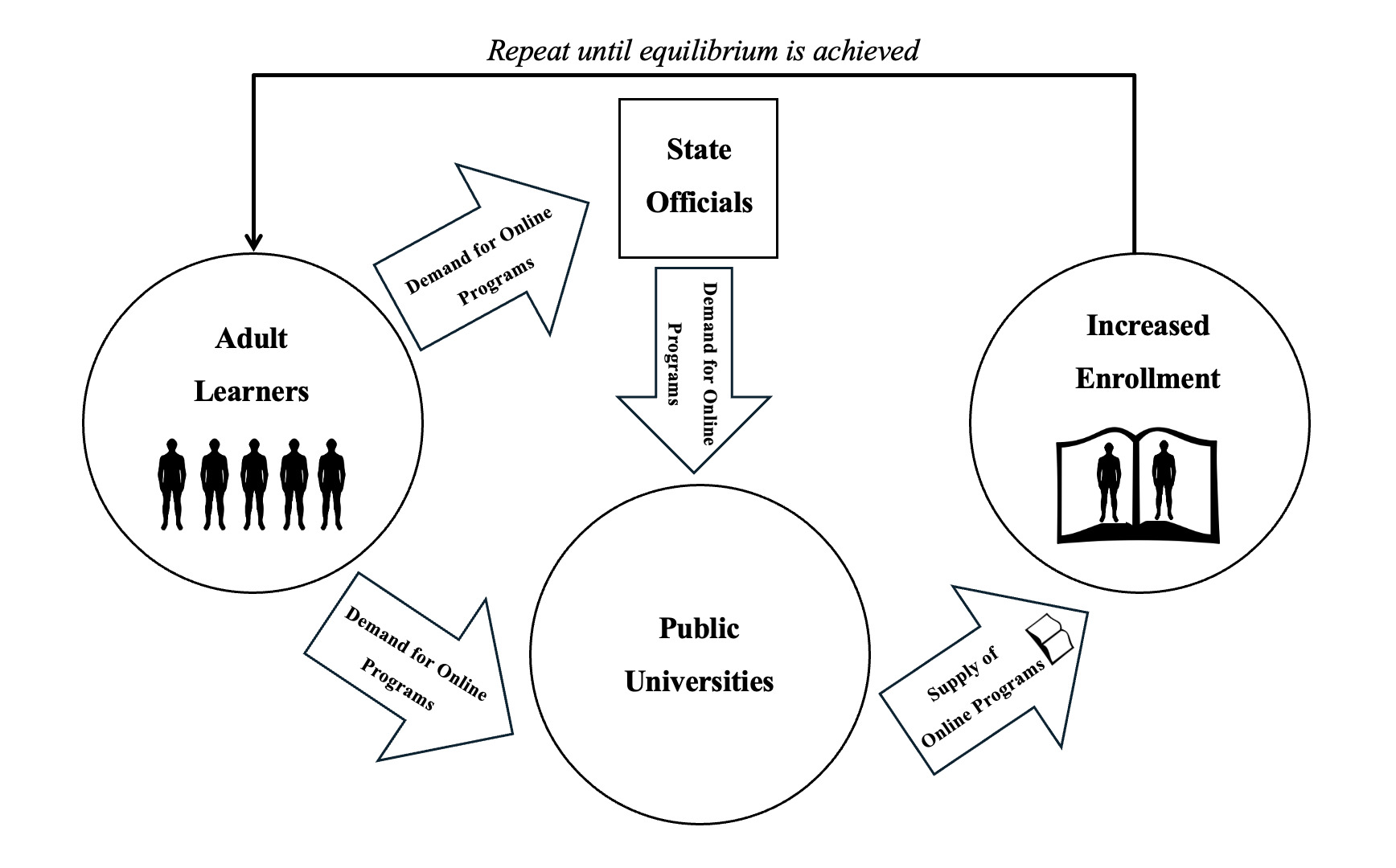
Universities that recognize the unique needs of adult learners and adapt their marketing, program offerings, and support structures accordingly have a higher likelihood of increased enrollment and graduation rates (Hegarty, 2011; Horii, 2007; Malik, 2016). In addition to pressure from prospective students, state officials exert influence on public universities to build programs that meet the perceived needs of their constituents (Cheslock & Riggs, 2023; Titus et al., 2015). If it was demonstrated that building online graduate programs at public universities would benefit their constituents, state officials would be incentivized to advocate for expanding online graduate programs. The demand from prospective students and state officials would continue until a point of equilibrium when public universities supply enough online graduate programs to meet the demand.
This study built on the premise that adult learners, and in particular graduate students, may have desires for pursuing higher education that differ from an overarching student population and what is currently offered by public universities. If adult learners (graduate students) are intrinsically motivated and modality-sensitive, then universities under enrollment pressure may rationally expand online offerings to attract this segment. This process will continue until equilibrium is achieved, where the supply of online programs is sufficient to meet the demand from learners (Figure 1).
Data
The primary data source is Integrated Postsecondary Education Data System (IPEDS). IPEDS is maintained by the U.S. Department of Education and consists of self-reported data from higher education institutions necessary for accreditation and federal funding (Congressional Research Service, 2007; National Center for Education Statistics, 2024). This examination explored three of the IPEDS sub-components: (a) Institutional Characteristics, (b) Fall Enrollment by Distance Education, and (c) Number of Programs Offered and Number of Programs Offered via Distance Education.
The analysis sample included all public four-year Title IV institutions based in the United States that report offering at least one graduate degree program (n = 570) between Academic Year 2012 through 2023. This analysis period represents all available data on distance education collected through IPEDS. IPEDS denotes additional subcategories for distance education starting in Academic Year 2018; however, for data harmonization, the data is grouped only by enrollment in some/all distance courses and enrolled in no distance courses.
This data set has multiple known limitations. IPEDS data is self-reported and universities may inadvertently misrepresent the number of programs that can be completed in-part through distance education, especially when considering elective courses. Additionally, IPEDS data collected in Academic Year 2020 and beyond include the distance education status for an unduplicated 12-month enrollment headcount and would provide a more precise representation of the percent of students enrolled in distance education courses beyond the Fall semester snapshot utilized in this examination. Lastly, the data is applicable for descriptive analysis but is very limited in causal analysis due to the many variables not accounted for in this study.
Results
This examination compiles data from IPEDS to inform a descriptive analysis and subsequently a statistical exercise. A discussion of the potential implications is included alongside the results in each respective section. To complement descriptive trends, we conducted an exploratory statistical analysis examining the association between online program availability and online graduate enrollment. While not causal, these correlations help assess whether increases in online program supply correspond with observed shifts in student demand.
National Trends in Online Graduate Enrollment
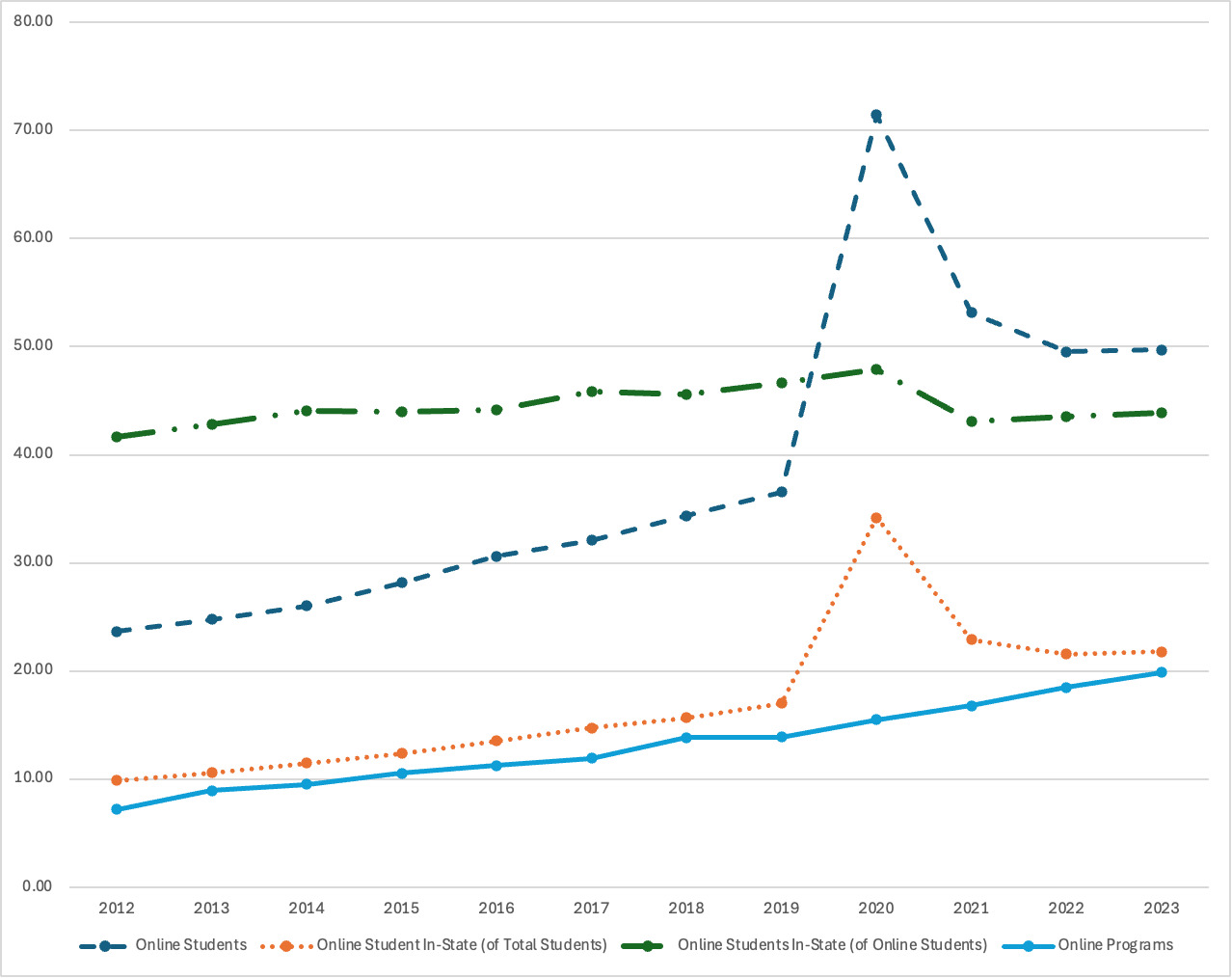
Consistent with previous studies and projections, the total number of graduate students enrolling in public four-year universities demonstrated generally consistent year-to-year growth of 1.19% (Table 1). The number of graduate students enrolling in online courses outpaced the overall year-to-year growth rate at 11.26%. Interestingly, the variance in growth for total enrollment proved more inelastic than online enrollment, which significantly fluctuated around Academic Year 2020 (COVID-19 pandemic). The post-pandemic online enrollment percent is currently holding around 50%; however, studies of prospective graduate students during that same timeframe indicate that upwards of 70% had a stated preference for fully-online programs (Simunich et al., 2024). This data implies that the demand for online graduate programs at public universities, represented by enrollment, has a potential for additional growth prior to reaching equilibrium.
The number of online graduate students who enrolled at a public four-year U.S. institution in their state of residence steadily increased, closely matching the overall online graduate student rate of growth at 12.32% year-to-year (Table 2). Despite the significant growth in the number and percent of online graduate students, the proportion of online graduate students who enroll in their state of residence remained relatively constant at 44% even during notable fluctuations in online enrollment attributed to the COVID-19 pandemic. This data suggest two main findings: an increase in online graduate enrollment proportionally correlates with an increase of in-state enrollment and the anticipated increase for in-state enrollment specifically at public universities is approximately 44% whereas Cheslock and Jaquette (2022) assert that 60% of all online students (undergraduate/graduate) enroll in programs (public/private) within their state of residence.
Expansion of Online Graduate Program Offerings
The number of graduate degree programs offered at public four-year U.S. institutions has also demonstrated consistent growth from Academic Year 2012 to 2023 (Table 3). This reliable growth demonstrates inelasticity by maintaining a relatively constant year-to-year change even during years with significant societal factors, like the COVID-19 pandemic. The average annual increase in online graduate programs was 12.34%; however, the starting point for percent of programs offered online was low (7.19%) and there are no notable spikes in online program creation to correct a potential supply shortfall (Figure 2).

Alignment Between Supply and Demand
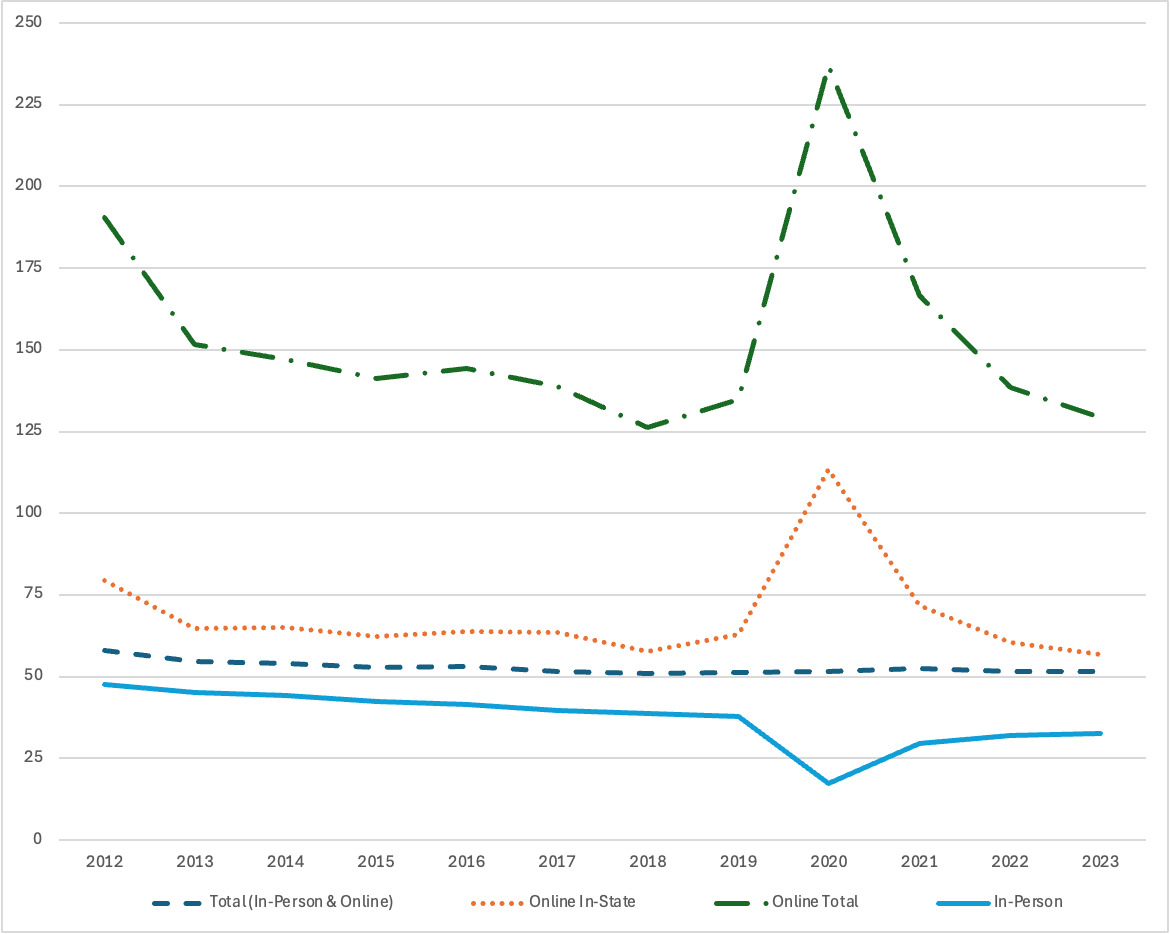
There is a clear and persistent discrepancy in the student-per-program ratio between online and in-person programs (Table 4). The overall graduate student enrollment per available program remained relatively constant between Academic Years 2012 through 2023 with a mean of 53 (SD = 1.97); however, in-person programs averaged 37 students (SD = 8.37) whereas online programs averaged more than four times that size at 154 students (SD = 31.51). This data suggest that public universities are overall creating a supply of graduate programs that is proportional to demand but are experiencing notably greater enrollment for online programs. This implies that public universities would experience higher enrollment, on average, for creating an online graduate program compared to an in-person program (Figure 3). Additional research should be conducted on whether the ideal graduate student-per-program ratio differs depending on modality.

A regression analysis was conducted to assess statistical significance between the factors examined in this study and to complement descriptive trends. An alpha of (α = 0.005) was set to reduce the risk of false positives (J. Miller & Ulrich, 2019). A Pearson correlation coefficient was calculated to examine the annual total of Fall Online Enrollment and the Number of Programs Offered Online. A strong positive correlation was observed between the two variables r(10) = 0.83, p < 0.001, demonstrating that a correlation exists between the increase in supply of online programs and the demand measured through enrollments. In comparing the annual total of Fall Online Enrollment and the number of Online Enrollment within the student’s state of residency, a strong positive correlation was also observed r(10) = 0.99, p < 0.001, reinforcing the concept that increasing the number of online graduate students at a public university will also relate to an increase of in-state enrollments. In summary, increasing the number of online programs offered at a public four-year university correlates with both an increase in overall enrollment and a proportional increase of in-state enrollments.
Limitations and Alternative Explanations
This examination explored descriptive statistics of online graduate students and programs covering all public four-year higher education institutions in the U.S. Results about trends over time may overstate or understate growth in fully online programs compared to partially online programs since these categories were grouped together. Due to its reliance on a descriptive analysis and not an inferential analysis, the results cannot verify correlation. Furthermore, the focus of this research on four-year public university graduate students limits its applicability to the broader categories of all university students and higher education institutions across the U.S. This selected scope addresses the category of public four-year higher education institutions and does not account for any nuanced factors that would need to be considered by individual institutions, including geography, tuition rates, institutional size, and more. This analysis focuses on the relationship of supply and demand and does not attempt to answer questions related to the value of online graduate programs, variances in higher education financing models, or the many factors that influence an individual’s desire to enroll within a specific graduate program.
One potential alternate explanation for the discrepancy in the supply of online graduate programs and the number of graduate students enrolling in online graduate programs could be attributed to variances in course sizes. Online programs do not have the same physical space constraints as in-person programs and could in theory accommodate a higher ratio of students per program and/or per course. Although this may be a contributing factor, it is unlikely that the 2012 supply of online graduate programs could adequately support the more than doubling of online graduate students extending to 2023—a fair market environment would raise supply with demand until the marginal gain equalizes or extends beyond demand to discover market equilibrium. With a generally constant increase of demand throughout the analysis period, it is unlikely that, even accounting for other factors like course size, supply has reached that cap.
Lastly, this data exploration does not distinguish whether there is a change in demand or change in quantity demanded. The extent to which prospective graduate students respond to the addition of an online graduate program in the higher education market compared to the conversion of already existing in-person graduate programs to an online format is unknown. There is also the potential for variances by academic program or field of study that were not addressed in this examination. The specific implications of demand and disciplinary differences should be explored in greater detail, and in particular, through an inferential analysis.
Conclusion
The rise in graduate student preference for online learning is well documented, as is the expansion of online program offerings at universities. Especially considering the advent of all-online universities that control a significant portion of the online student market, previous research did not speak to whether there was sufficient demand for online programs at public four-year institutions. Furthermore, with strained university budgets and political pressure from state officials to uphold institutional missions around serving state residents, existing research did not address to what extent creating online graduate programs reach state residents or operate in a national marketplace.
This study explored theoretical insights by treating graduate enrollment as demand, number of graduate programs as supply, and positing a correlation between respective changes. Adult learner preferences for online learning and institutional responsiveness jointly shape online higher education markets. An increase in the number of adult learners who are pursuing online education would theoretically necessitate an increase in the number of online graduate programs. This examination not only demonstrated a correlation between supply and demand, but uncovered a lag in the supply of online graduate programs at public universities compared to the rapidly expanding demand.
The treatment of online graduate programs as an inelastic supply source compared to an elastic demand of graduate students is novel in this study and carries theoretical and practical implications. Academic institutions that strive to match student demand should consider the elasticity of their programs—national data explored in this analysis suggest that when presented with high levels of demand for online graduate programs (e.g. COVID-19 pandemic), public institutions as a whole were unable to adjust the supply of programs accordingly. Public institutions, especially those facing fiscal constraints, could benefit from clear and agile procedures to maximize on student demand as changes in the marketplace occur.
Public universities and states must reconsider funding and competitive strategies to sustain enrollment and program viability. Online graduate programs at public universities are demonstrated to enroll a consistent proportion of in-state students while also benefiting from additional revenue through out-of-state enrollments. Online graduate programs attract in-state and out-of-state students, average quadruple the enrollment compared to in-person programs, and are poised to continue growing as demand increases.
This study was novel in its use of nationally aggregated data to explore supply and demand trends; however, it was limited in its ability to determine a causal relationship between number of online programs and enrollment. Additionally, the study was based predominantly on available descriptive IPEDS data, which necessitated Fall-enrollment data versus unduplicated 12-month headcount. The examination is limited in scope to public four-year universities in the U.S. and should be expanded to explore potential similar trends in private/non-profit four-year institutions and private/for-profit institutions. Furthermore, additional variance may be present when examining a specific state’s graduate student enrollment market compared to national averages. Future studies should analyze the factors that impact online graduate enrollment both nationally and within regional markets. This examination is descriptive, but it establishes a baseline for future causal research using student-level or longitudinal data.